Guide · 12 min read · Oct 30, 2026
Dutch angle: what it is, film examples and when to use it
A dutch angle (also called a Dutch tilt or canted angle) is a shot where the camera is rolled around its lens axis so the horizon sits at a slant. Filmmakers use it to make viewers feel uneasy. Its earliest recorded use is a 1906 American film, and a 15 to 20 degree roll is a common starting point.
A dutch angle is one of the easiest camera tricks to copy and one of the easiest to overdo. This guide covers what the shot is, where the odd name comes from, film examples from Caligari to Thor, how it differs from a tilt or a low angle, and how to shoot one on a phone, a camera or an AI video model. For the basic vocabulary of pans, tilts and other moves, see our guide to camera movements and angles.
The facts here were checked on October 30, 2026 against Wikipedia's dutch angle article, film education sites like Backstage, and news coverage of Kenneth Branagh's recent comments about Thor. Where sources disagree, we say so.
What is a dutch angle?
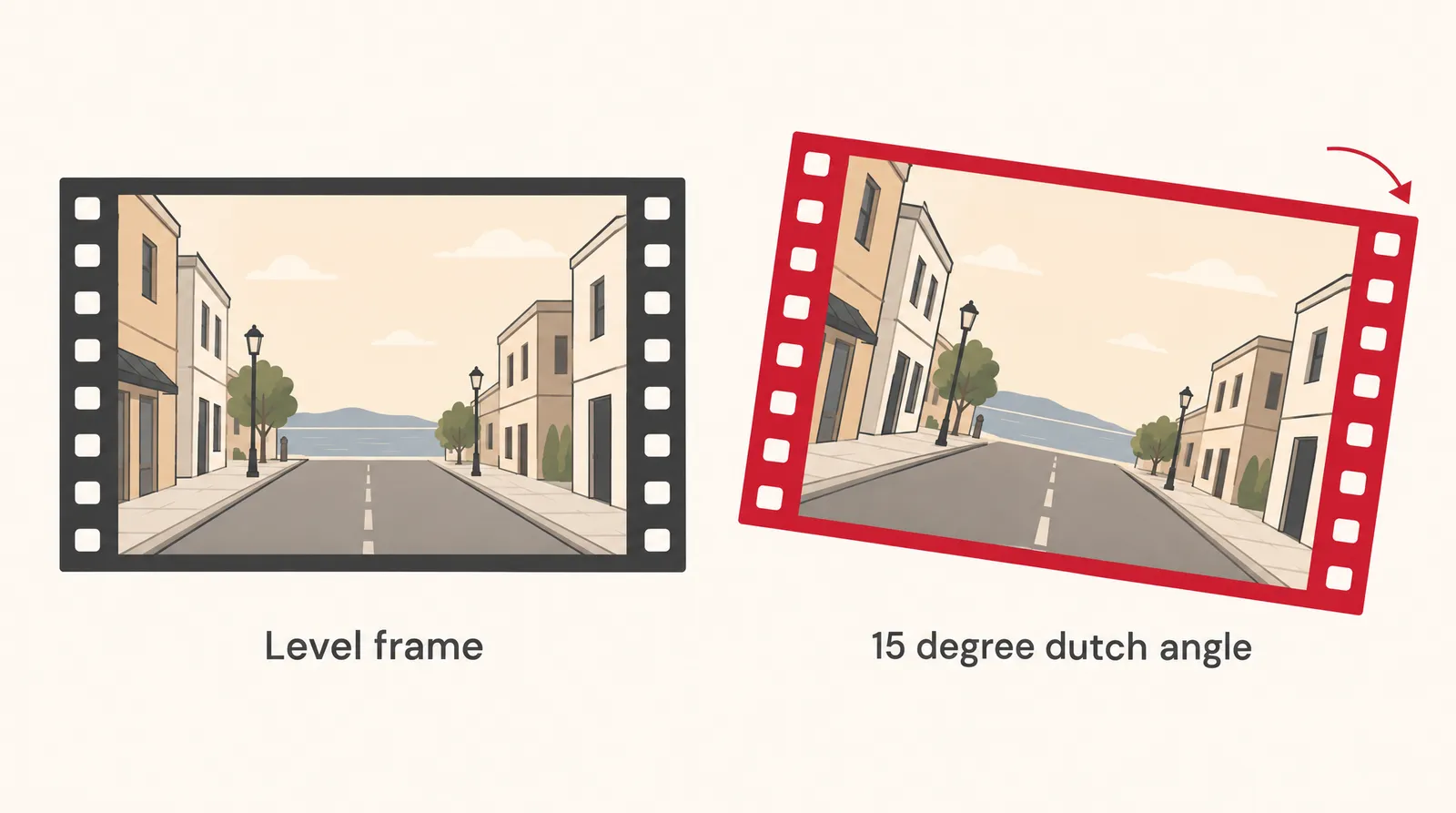
A dutch angle is a shot where the camera is rotated around the axis of its lens, so the horizon isn't parallel with the bottom of the frame and vertical lines lean to one side, according to Wikipedia. The result looks like tilting your head sideways. The same shot also goes by Dutch tilt, canted angle, oblique angle, vortex plane or a Durkin.
Most dutch angles are static: the camera holds the slanted frame. When the camera does move, it can pivot, pan or track along the diagonal set for the shot, as Wikipedia notes citing Mamer's Film Production Technique (2008). There's no official degree, but creators' prompt examples commonly use 15 or 20 degrees, which makes a sensible starting point.
Why is it called a dutch angle?
Nobody knows for certain why it's called a dutch angle. One theory, "held by some" according to Wikipedia, is that "Dutch" is a corruption of the German "Deutsch," because German expressionist films used the shot widely to show madness, unrest and disorientation. The other theory is that "Dutch" marks something out of line or out of the ordinary, as in a Dutch roll.
The shot is older than German Expressionism. Its earliest recorded use is Edwin S. Porter's American film Dream of a Rarebit Fiend (1906), and Backstage credits The Cabinet of Dr. Caligari (1920) with bringing it to public attention.
What is a dutch angle used for?
A dutch angle is used mainly to make the viewer feel uneasy or disoriented, often to show a character's psychological strain or a tense situation. Directors apply it in a few recurring ways.
- Signal coming trouble: Casino (1995) opens a hotel scene at a level angle, then switches to a dutch angle to hint at the chaos an affair will cause.
- Build tension: in Mission: Impossible (1996), the tilts in the restaurant conversation get steeper as the tension rises.
- Mark a character: the 1960s Batman series and the 1966 film gave each villain their own tilt because they were "crooked."
- Show madness or possession: Sam Raimi uses it in Evil Dead to show that a character is possessed.
- Mix unease with power: a low dutch angle, shot from below and tilted, combines the tilt with a sense of power, per Epidemic Sound.
In a montage of dutch angles, the direction often alternates: a shot tilted right is followed by one tilted left.
Dutch angle examples in film
The best-documented dutch angle examples run from silent film to Marvel, and the table below lists what the tilt does in each.
Dutch angle examples in film
| Film | Year | What the tilt does |
|---|---|---|
| Dream of a Rarebit Fiend | 1906 | Earliest recorded use, by Edwin S. Porter |
| The Cabinet of Dr. Caligari | 1920 | Brought the shot to public attention |
| Man with a Movie Camera | 1929 | Dziga Vertov's documentary uses dutch angles |
| Suspicion, Notorious, Strangers on a Train, The Man Who Knew Too Much | 1941, 1946, 1951, 1956 | Hitchcock, who spent time at UFA studios in Germany early on |
| The Third Man | 1949 | Used heavily; William Wyler sent Carol Reed a spirit level |
| Batman (film) | 1966 | Each villain gets their own tilt |
| Casino | 1995 | Level shot switches to a tilt to foreshadow chaos |
| Mission: Impossible | 1996 | Tilts steepen as a conversation gets tenser |
| Battlefield Earth | 2000 | Tilted almost everywhere; widely criticized |
| Thor | 2011 | Packed with canted angles for comic-style impact |
Sources: Wikipedia, Backstage, JoBlo (Thor). Checked October 30, 2026.
Terry Gilliam (Brazil, 12 Monkeys, Fear and Loathing in Las Vegas) and Tim Burton are also known for the shot. In games, horror titles with fixed cameras use it, especially early Resident Evil and Silent Hill.
Why does Thor have so many dutch angles?
Thor (2011) has so many dutch angles because director Kenneth Branagh wanted them for "visual impact," pointing to classic Kirby-era comic book framing. In September 2026, on the On Film…With Kevin McCarthy podcast, he said Marvel had asked what it would cost to "horizontalize" the movie and the price was prohibitive, according to JoBlo. Some articles, including Movieweb, tie Branagh's tilts to Thor: The Dark World (2013), but his film was the first Thor.
Dutch angle vs tilt, canted angle and low angle
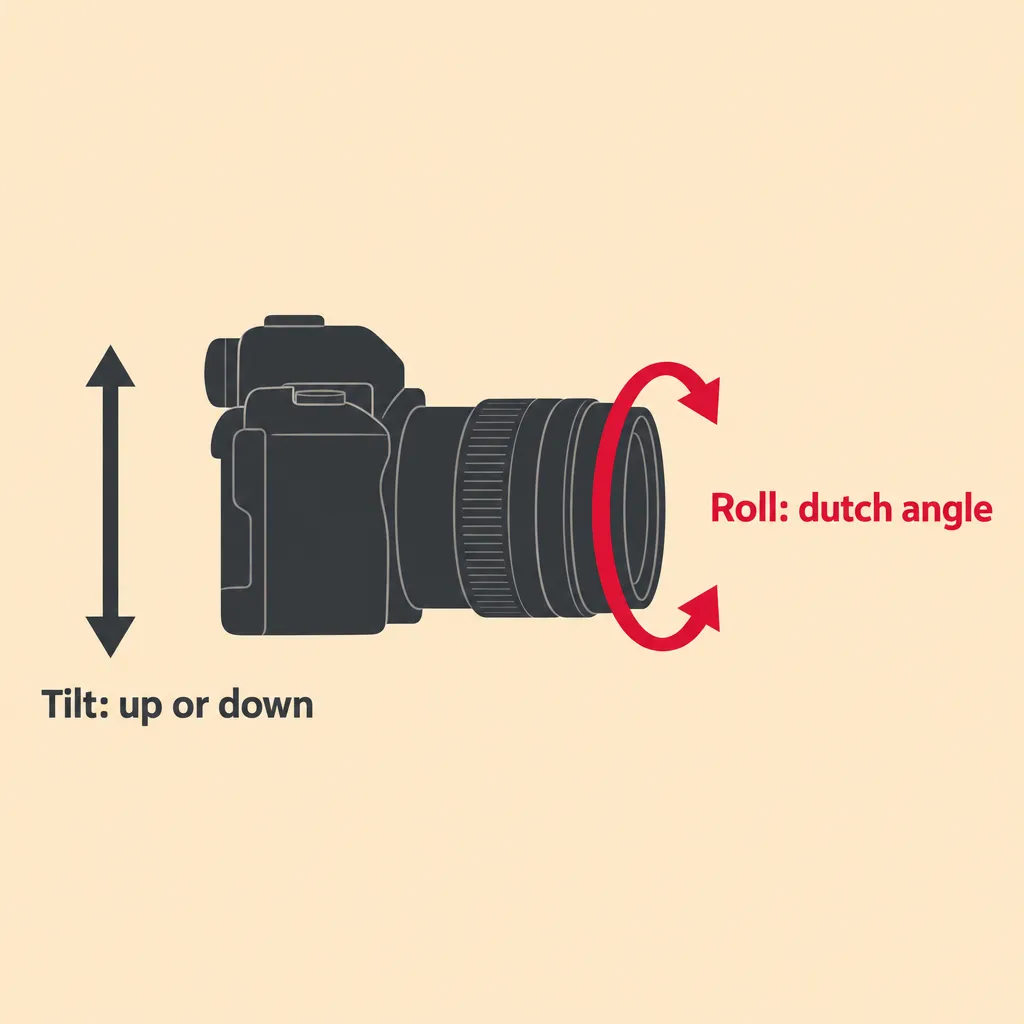
A dutch angle is a roll, not a tilt: the camera rotates around the lens axis so the horizon slants, while a regular tilt points the camera up or down and keeps the horizon level. Our camera movements guide covers tilts, pans and the other basic moves.
- Dutch angle vs tilt: a tilt changes where the camera points vertically; a dutch angle rotates the frame itself.
- Dutch angle vs canted angle: they're the same shot. Canted angle, Dutch tilt and oblique angle are alternative names.
- Dutch angle vs low angle: a low angle is about camera height, shooting up at the subject with a level horizon. Combine the two and you get a low dutch angle.
How to take a dutch angle shot with a phone or camera
To take a dutch angle shot, roll your phone or camera about 15 to 20 degrees around the lens, hold that frame still for one story beat, then cut back to a level shot. Here's the full sequence.
- Pick the beat: Choose the one moment where the scene or character should feel off balance, such as a reveal or a bad decision.
- Frame it level first: Compose the shot with a straight horizon so you know exactly what you're rotating away from.
- Roll 15 to 20 degrees: Rotate the phone or camera like a steering wheel around the lens. Don't point it up or down.
- Keep the subject readable: Check that the face or key object stays fully in frame after the rotation.
- Hold it static: Record the beat without moving. If you must move, pan or track along the same diagonal.
- Alternate in a sequence: If you cut between several tilted shots, switch the tilt direction from right to left.
- Cut back to level: Return to a level shot after the beat so the contrast does the work.
The same steps work for a dutch angle photo: make the roll clearly deliberate so it reads as a choice rather than a crooked horizon. If you're planning a sequence, sketch each tilted frame in a storyboard so you can see where the level shots fall.
When not to use a dutch angle
Don't use a dutch angle on every shot: the effect works through contrast with level shots and wears off when overused, as Wedio points out. Battlefield Earth (2000) is the classic warning. It was heavily criticized for tilting nearly everything, and Roger Ebert wrote that the director had learned directors sometimes tilt their cameras "but he has not learned why."
Heavy use isn't automatically wrong. Thor tilts constantly, and Branagh defends it as a deliberate style tied to comic book framing. The useful test is whether you can say what the tilt means in that moment.
- Skip it for calm or neutral moments, where unease would send the wrong signal.
- Skip it in tutorials, interviews and product demos, where viewers need to read details easily.
- Skip it when you can't name the feeling the tilt is supposed to add.
How to get a dutch angle in an AI video
You get a dutch angle in an AI video by naming the shot, the degree and a static camera in your prompt, for example "static 15-degree Dutch angle." Third-party guides such as fal.ai's Veo 3 prompt guide list "Dutch angle" as a standard shot term, and VEED says Veo 3.1 interprets it accurately. That's a third-party claim, not Google's, and results vary by model and by generation.
Sample prompt: Static 15-degree Dutch angle, medium shot of a night-shift nurse standing alone in a flickering hospital corridor, horizon tilted to the right, cold fluorescent light, uneasy mood, no camera movement. It works because it names the angle and degree, rules out camera moves that could cancel the tilt, and tells the model what feeling the tilt should carry. Creators use similar fixed values, like a "20° Dutch tilt. 5s static hold" or a "15-degree dutch angle tilt static shot".
On Klakix, open Text to Video, pick a model and paste the prompt. Google Veo 3.1 Lite costs 40 credits for an 8-second 720p clip, Seedance 2.0 Mini costs 48 credits for 5 seconds at 720p (about $3.20 on the $5 Mini pack, our math: 48 of its 75 credits), and MiniMax H3 Max Turbo costs 20 credits for a 5-second 768p draft. Prices checked October 30, 2026; may change. If a generation fails, its credits are refunded automatically.
To check the framing before paying for video, generate a tilted still with Nano Banana 2 in Image Generation for 8 credits, then use it as the first frame in Image to Video. Klakix doesn't combine clips, so generate your level shots separately and cut the sequence in your own editor. The 20 free signup credits only work for voiceovers; video needs a credit purchase, listed on the pricing page. Klakix is not affiliated with Google, ByteDance or MiniMax.
Sources
The facts in this post were checked against the pages below on Oct 30, 2026. Prices and limits may change.
- Wikipedia: Dutch angle (independent source)
- Backstage: What is a Dutch angle (independent source)
- MasterClass: Understanding the Dutch angle (independent source)
- Epidemic Sound: What is a Dutch angle (independent source)
- JoBlo: Kenneth Branagh on Thor's Dutch angles (news)
- Movieweb: The Dutch angle explained (independent source)
- Wedio: Dutch angle (independent source)
- fal.ai: Veo 3 prompt guide (independent source)
- VEED: Veo 3.1 prompts (independent source)
- 25 camera angle prompts for cinematic video (Substack) (independent source)
- Veo3 camera movements and shot types prompts (Medium) (independent source)
This post was drafted with AI assistance. Facts were checked against the sources above, and model, credit and price details were checked automatically against the site's current price list.
Frequently asked questions
What is a dutch angle shot?
It's a shot where the camera is rotated around its lens so the horizon and vertical lines sit at a slant. It feels like tilting your head to one side. It's also called a Dutch tilt or canted angle.
What is a dutch angle used for?
It's used to make viewers feel uneasy or disoriented. Directors reach for it when a character is losing control, when tension is building, or to mark someone as a villain. It works best when it's surrounded by level shots.
Is a dutch angle the same as a canted angle?
Yes. Canted angle, Dutch tilt, oblique angle and dutch angle all describe the same rolled frame. The names differ by habit, not by technique.
What's the difference between a dutch angle and a low angle?
A low angle places the camera below the subject and looks up, usually with a level horizon. A dutch angle rotates the frame so the horizon slants. You can combine them into a low dutch angle that feels both powerful and off balance.
Why does Thor have so many dutch angles?
Kenneth Branagh chose them for visual impact, inspired by classic Kirby-era comic panels. In 2026 he said Marvel had looked into the cost of straightening the footage, and it was too expensive. His film was the first Thor from 2011, not the sequel.
What is a dutch angle in photography?
In photography it means the same thing as in film: you rotate the camera so the horizon tilts on purpose. It suits tense, playful or chaotic subjects. Make the angle obvious enough that it doesn't look like a mistake.
How do you draw a dutch angle?
Draw your scene's horizon line on a diagonal instead of horizontally, and lean all vertical lines like walls and doorframes by the same amount. Keep the angle consistent across the whole frame. Around 15 to 20 degrees is an easy starting point.
How many degrees is a dutch angle?
There's no standard number. Creators often use 15 or 20 degrees, and some films increase the angle as a scene gets tenser. Pick a value that reads clearly as intentional and keep it steady for the shot.
Try what you just read
Signing up is free. Video and image tools unlock after your first credit pack, and credits are refunded if a generation fails.
Open Text to Video