Guide · 12 min read · Nov 1, 2026
Low angle shot: meaning, examples and how to frame it
A low angle shot places the camera anywhere below the subject's eye line and tilts it up. Adobe describes it as typically about 45 degrees. It makes a subject look larger, taller and closer, so filmmakers use it for heroes, villains and monsters. Research shows the effect depends on context, so it isn't automatically powerful or flattering.
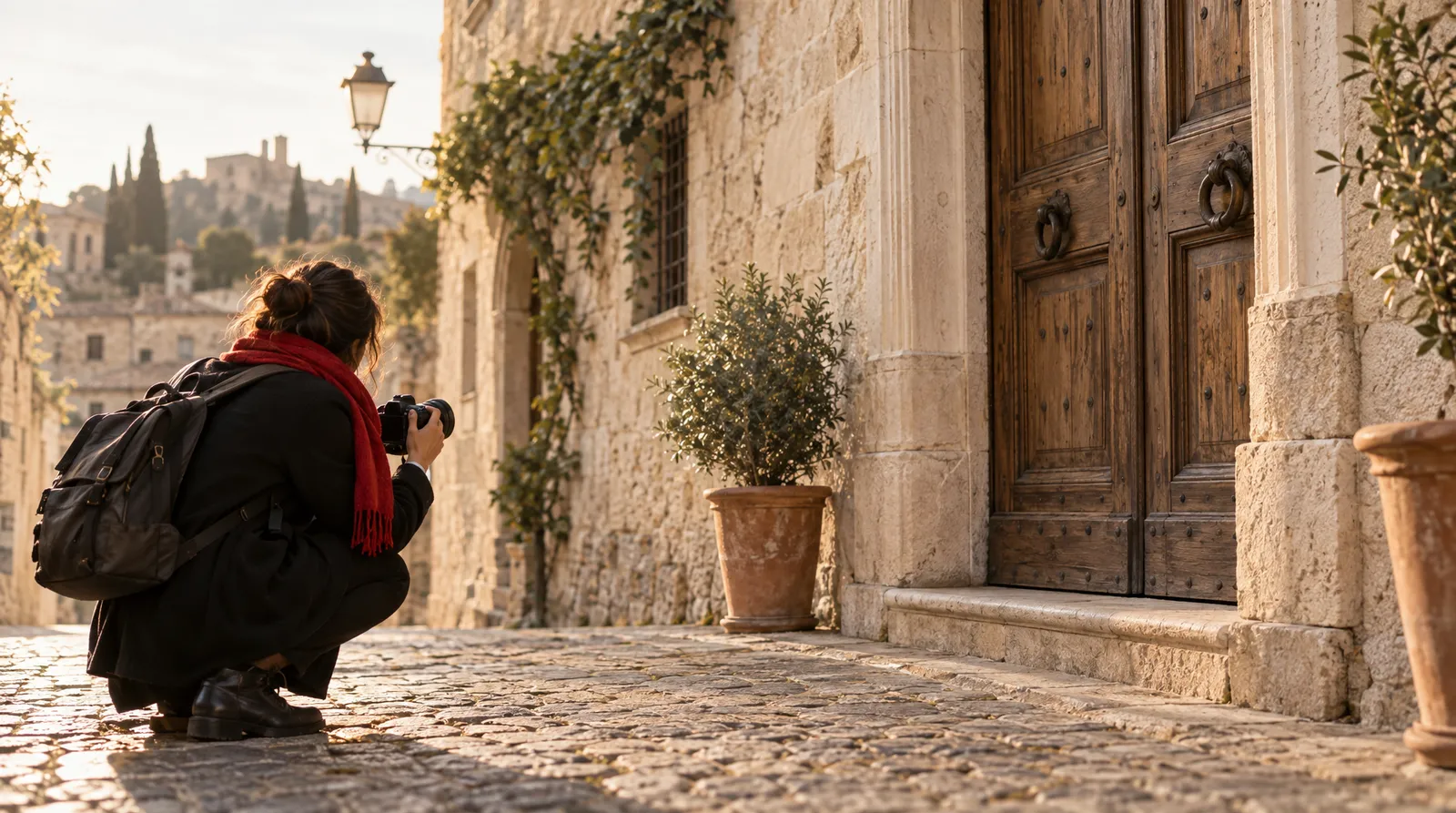
This guide covers the low angle shot from four directions: what it means, how it differs from worm's-eye and high angle views, which famous film scenes use it, and how to frame one with a phone, a camera, a pencil or an AI video prompt. It sits alongside our broader guide to camera movements and angles.
Definitions come from Wikipedia, Adobe, StudioBinder and Soundstripe, the viewer-effect claims from a peer-reviewed 2017 study, and the AI prompt wording from Google's official Vertex AI guide. Everything was checked on November 1, 2026.
What is a low angle shot? Meaning and definition
A low angle shot is a shot taken from a camera position low on the vertical axis, anywhere below the eye line, looking up at the subject, as Wikipedia defines it. Sometimes the camera sits directly below the subject's feet. In production settings the same shot is also called an upshot, according to Soundstripe.
How low is low? Adobe says low angle shots are typically taken at about 45 degrees, but they can range from a few inches below the eye line all the way down to the ground. Treat the 45 degree figure as Adobe's convention, not a fixed standard. StudioBinder agrees the angle can be just slightly below the subject or point nearly straight up.
Low angle shot vs high angle shot vs worm's-eye view
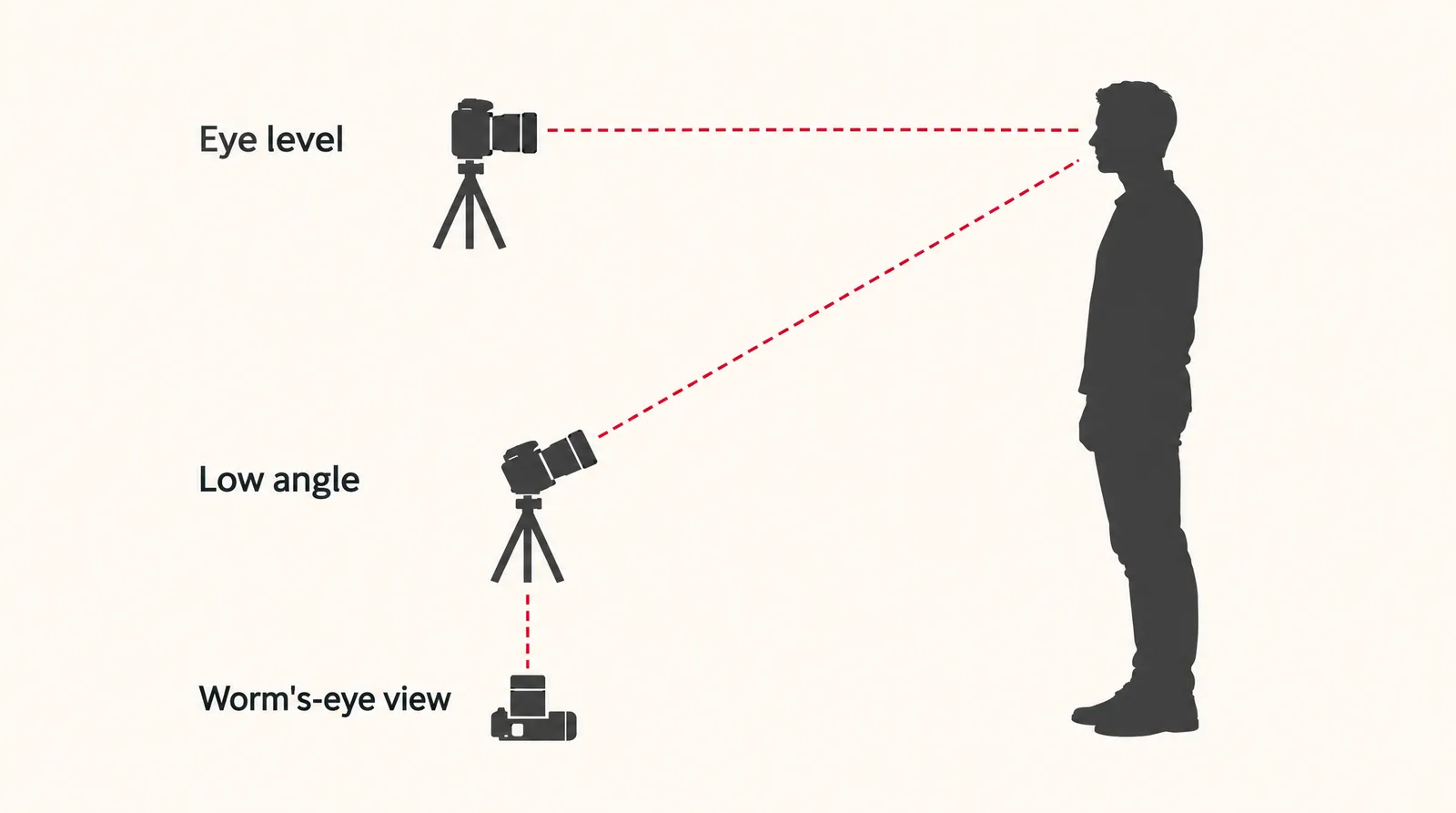
The difference between these angles is camera height and tilt: a low angle is anything below eye line looking up, a worm's-eye view is the extreme version from the ground, and a high angle sits above eye line looking down. Soundstripe splits low angles into three types: standard, extreme and worm's-eye.
Camera angles compared
| Angle | Camera position | Tilt | Commonly described effect |
|---|---|---|---|
| Eye level | At the subject's eye line | None | Neutral; rated most trustworthy in a 2017 study |
| Low angle (standard) | Anywhere below the eye line | Up, often about 45 degrees (Adobe) | Subject looks larger, taller, closer |
| Extreme low angle | Below the subject's feet | Steeply up | Strong exaggeration of size |
| Worm's-eye view | Flat on the ground | Straight up | Most extreme; often uses three-point perspective |
| High angle | Above the eye line | Down | The 2017 study found it lowered trust as much as a 30 degree low angle |
Sources: Wikipedia, Adobe, StudioBinder, Soundstripe, Baranowski and Hecht (2017). Checked November 1, 2026.
Wikipedia notes that a worm's-eye view is also called a frog's-eye view and is the inverse of a bird's-eye view. The Photography Institute draws the same line: any photo from below eye level is a low angle, while worm's-eye means the lowest possible point. Some people use "low shot" to mean a low camera height without an upward tilt, but that distinction is not confirmed by an official source.
What is a low angle shot used for in film?
A low angle shot is mostly used to change how big and present a subject feels. Adobe says it makes a subject appear larger, wider, taller and closer, which filmmakers use to make monsters scarier, heroes or villains more powerful, and victims more vulnerable. It can also make a building or a set loom over the viewer.
Low angle shot examples in movies
The most commonly cited low angle shot examples come from classic and modern films, many of them listed on Wikipedia's low-angle shot page. That article carries a "multiple issues" banner, so treat the list as commonly cited rather than definitive. The notes on why each works are our reading of the scene.
- M (1931): Fritz Lang shoots Inspector Lohmann from under his desk, so the investigator dominates the frame.
- Citizen Kane: the scene where Leland confronts Kane after the election defeat is entirely low angle. The sets are commonly reported to have been built with ceilings so those shots would show them, a technique PremiumBeat notes John Ford had used earlier in Stagecoach.
- Godzilla (1954): the monster is shot mostly from low angles, which keeps it towering over the audience.
- Psycho: the Bates house is usually shot from below, so it looms over everyone who approaches it.
- Star Wars: Darth Vader's first appearance in the hallway uses a low angle to introduce a threatening figure.
- The Dark Knight: after the truck flip, the shot of the Joker moves from a medium close-up into a low angle.
- Full Metal Jacket: Hartman yelling at Joker is framed from below, stressing the drill instructor's control.
If you're planning a sequence like these, mark the angle on each panel of your storyboard so the low shots stay rare and deliberate. A tilted horizon is a different tool, covered in our Dutch angle guide.
How to take a low angle shot with a phone or camera
To take a low angle shot, lower the camera below your subject's eyes, step back, and tilt up only as much as you need. The steps below work for portraits, products and buildings.
- Decide the goal: Choose what the angle should do for this shot: make a person look taller, a product look bigger or a building loom.
- Lower the camera: Bring your phone or camera down to chest or knee height, below the subject's eye line.
- Step back: Move a few steps away from a person instead of shooting up from close range, which keeps the chin and nostrils in proportion.
- Go wider: On a camera, use a lens below 50 mm, which NFI recommends to emphasize the subject; on a phone, use the widest lens you're comfortable with.
- Tilt up gently: Start with a slight upward tilt and increase it only if the shot still looks flat.
- Check the background: Look at what fills the top of the frame, usually ceiling or sky, and move until it's clean or meaningful.
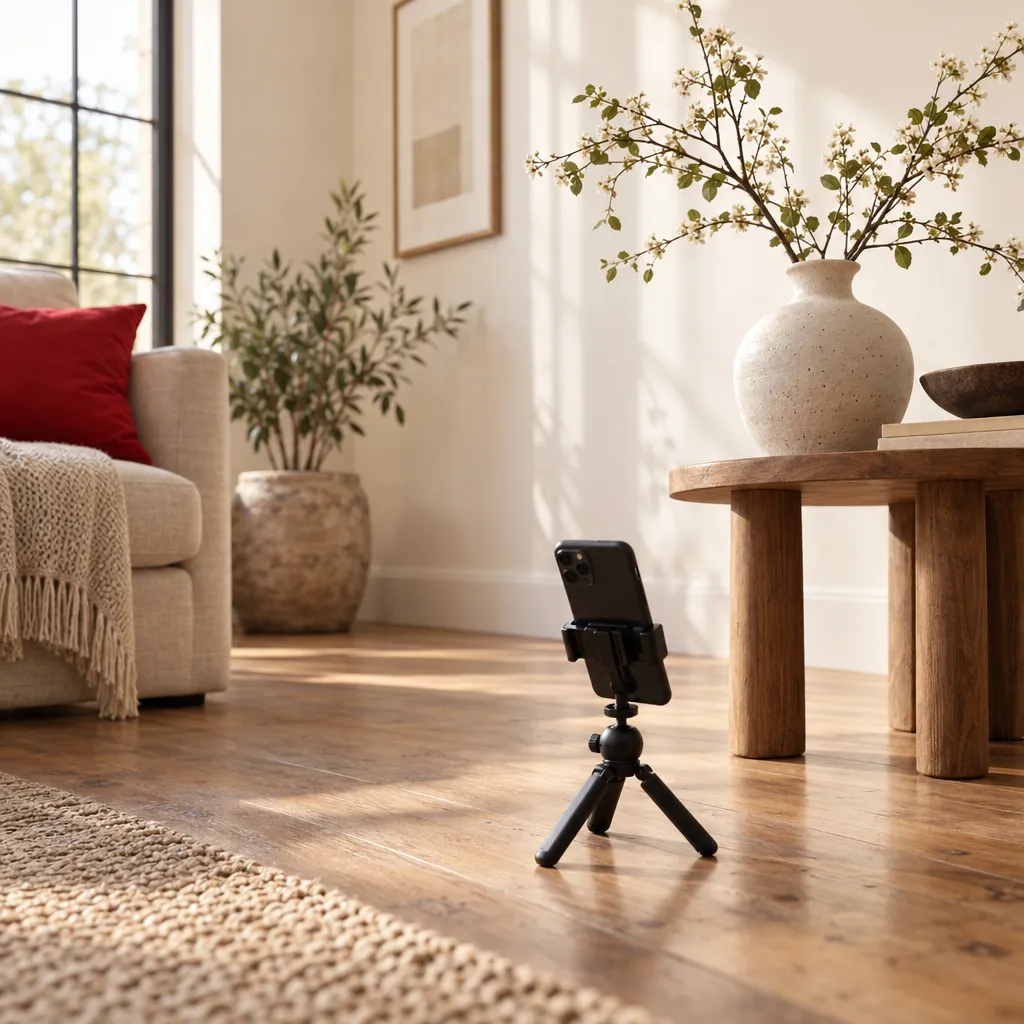
- Steady it: For ground-level shots, set the camera on a small tabletop tripod about 6 inches (15 cm) tall.
The lens and tripod tips come from NFI's low angle photography guide. On a phone, a low grip near the ground plus a few test frames usually tells you more than any rule.
How to draw a low angle shot
Drawing a low angle usually means using three-point perspective, the method Wikipedia mentions for worm's-eye views. Place two vanishing points on a low horizon line and a third high above the subject, so vertical lines converge upward. Feet and legs get larger and closer, while the head shrinks toward the top vanishing point.
Common low angle shot mistakes
Most low angle problems come from shooting too close, ignoring the background or using the angle too often. Several photography guides, including Fstoppers and Photography Icon, point to the same three issues.
- Nostrils and chin: shooting up at a face from close range exaggerates both. A slight low angle from a few steps back usually works better.
- Empty ceilings and skies: a low angle shows what's above the subject, so a blank ceiling or a power line can take over the frame.
- Overuse: if every shot looks up, none of them stands out. Save the angle for the moment that needs it.
How to describe a low angle shot for media studies
To describe a low angle shot, name the angle, say where the camera is, explain the visual result and tie it to the story. A template you can adapt: "The camera is placed below [character]'s eye line and tilts up at them, so they fill more of the frame and appear taller. Because this happens when [story moment], the angle suggests [power, threat or vulnerability]."
The last sentence matters most. Since research shows the effect depends on context, a strong answer explains why the angle means something in this scene instead of claiming low angles always mean power.
How to get a low angle shot in AI video and images
To get a low angle shot from an AI video generator, write the angle at the start of the prompt in plain film terms. Google's official Vertex AI prompt guide defines a low-angle shot as the camera below the subject looking up, uses the example "low-angle tracking shot of a superhero landing", and warns that results may vary depending on the overall prompt. Google's Veo 3.1 prompting guide lists "low angle" as a composition term and "wide-angle lens" as a lens term.
- Hero shot: "Low-angle shot, camera near the ground looking up at a baker standing in a bakery doorway at sunrise, wide-angle lens, warm light, steam drifting from fresh bread, slow push in."
- Product: "Low-angle close-up of a white sneaker on a wet street, camera just above the pavement looking up, overcast sky behind, puddle reflections."
- Architecture: "Worm's-eye view looking straight up at an old clock tower, clouds moving fast, wide-angle lens, late afternoon light."
These work because each one names the angle first, says where the camera physically is, adds a lens term from Google's vocabulary and describes what fills the background, which is the part low angles reveal.
On Klakix, you can paste these prompts into Text to Video. Google Veo 3.1 Lite costs 40 credits by default (720p, 8 seconds, 9:16 or 16:9), which is about $2.67 on the Mini pack by our math ($5 ÷ 75 credits × 40). For cheaper test runs, MiniMax H3 Max Turbo is 20 credits for 5 seconds at 768p. If you want a still frame first, Image Generation runs Nano Banana 2 at 8 credits or Muse Image at 2 credits. Prices checked November 1, 2026; may change, see pricing.
For planned camera work, the beta 3D Scene tool lets you assign one of 16 camera moves to each shot of a blockout, and the camera work itself is free. No AI model follows angle instructions every time, so expect to rerun a prompt or adjust the wording.
Sources
The facts in this post were checked against the pages below on Nov 1, 2026. Prices and limits may change.
- Wikipedia: Low-angle shot (independent source)
- Adobe: Low-angle shot (independent source)
- StudioBinder: Low angle shot (independent source)
- Soundstripe: Low angle shot (independent source)
- The Photography Institute: Worm's-eye view photography (independent source)
- Baranowski and Hecht (2017), Empirical Studies of the Arts (independent source)
- PremiumBeat: How to Citizen Kane your film (independent source)
- NFI: Low angle photography (independent source)
- Fstoppers: 10 mistakes that kill a headshot (independent source)
- Photography Icon: Photography angles (independent source)
- Google Cloud: Vertex AI video generation prompt guide (official source)
- Google Cloud blog: Ultimate prompting guide for Veo 3.1 (official source)
This post was drafted with AI assistance. Facts were checked against the sources above, and model, credit and price details were checked automatically against the site's current price list.
Frequently asked questions
What is a low angle shot in film?
It's a shot where the camera sits below the subject's eye line and looks up at them. The position can be a few inches below the eyes or all the way down at the floor. Adobe describes the typical angle as about 45 degrees.
How does a low angle shot affect the audience?
It usually makes the subject look larger, taller and closer, so it's often used for heroes, villains and monsters. A 2017 study found that a 30 degree low angle actually lowered trust compared with eye level. The scene and story decide how viewers read it.
What is an extreme low angle shot called?
StudioBinder calls a camera placed below the character's feet an extreme low angle shot. When the camera sits flat on the ground pointing straight up, it's called a worm's-eye view or frog's-eye view. In production, a low angle is sometimes called an upshot.
Low angle shot vs high angle shot: what's the difference?
A low angle places the camera below eye level looking up, while a high angle places it above eye level looking down. Low angles are conventionally used to make subjects look bigger. In one controlled study, both angles reduced trust about equally compared with eye level.
Is a low angle shot the same as a worm's-eye view?
No. A low angle is any shot from below eye line, even slightly below. A worm's-eye view is the most extreme version, taken from the ground and often pointing straight up.
Is a low angle shot flattering for portraits?
It can be, but only when it's subtle. Shooting up at a face from close range exaggerates the chin and nostrils. A slight low angle from a few steps back is the safer choice.
How do I prompt a low angle shot in an AI video generator?
Put the angle at the start of the prompt, for example "low-angle shot, camera near the ground looking up at" followed by the subject. Add a lens term such as wide-angle lens and describe the sky or ceiling behind. Google notes that results can vary with the rest of the prompt.
Can I make low angle AI videos on Klakix for free?
No. The 20 free credits you get after verifying your email work only for voiceovers. Video and image tools unlock after your first credit purchase, starting with the Mini pack at 75 credits for $5.
Try what you just read
Signing up is free. Video and image tools unlock after your first credit pack, and credits are refunded if a generation fails.
Open Text to Video