Guide · 13 min read · Nov 9, 2026
Tracking shot: types, famous examples and how to plan one
A tracking shot is any shot where the camera physically travels with a subject: following behind, leading in front or moving alongside it. It can last a few seconds or run about 6 minutes, as in Children of Men. Tracks and dollies are optional. Steadicam, gimbals, drones and handheld rigs all count.
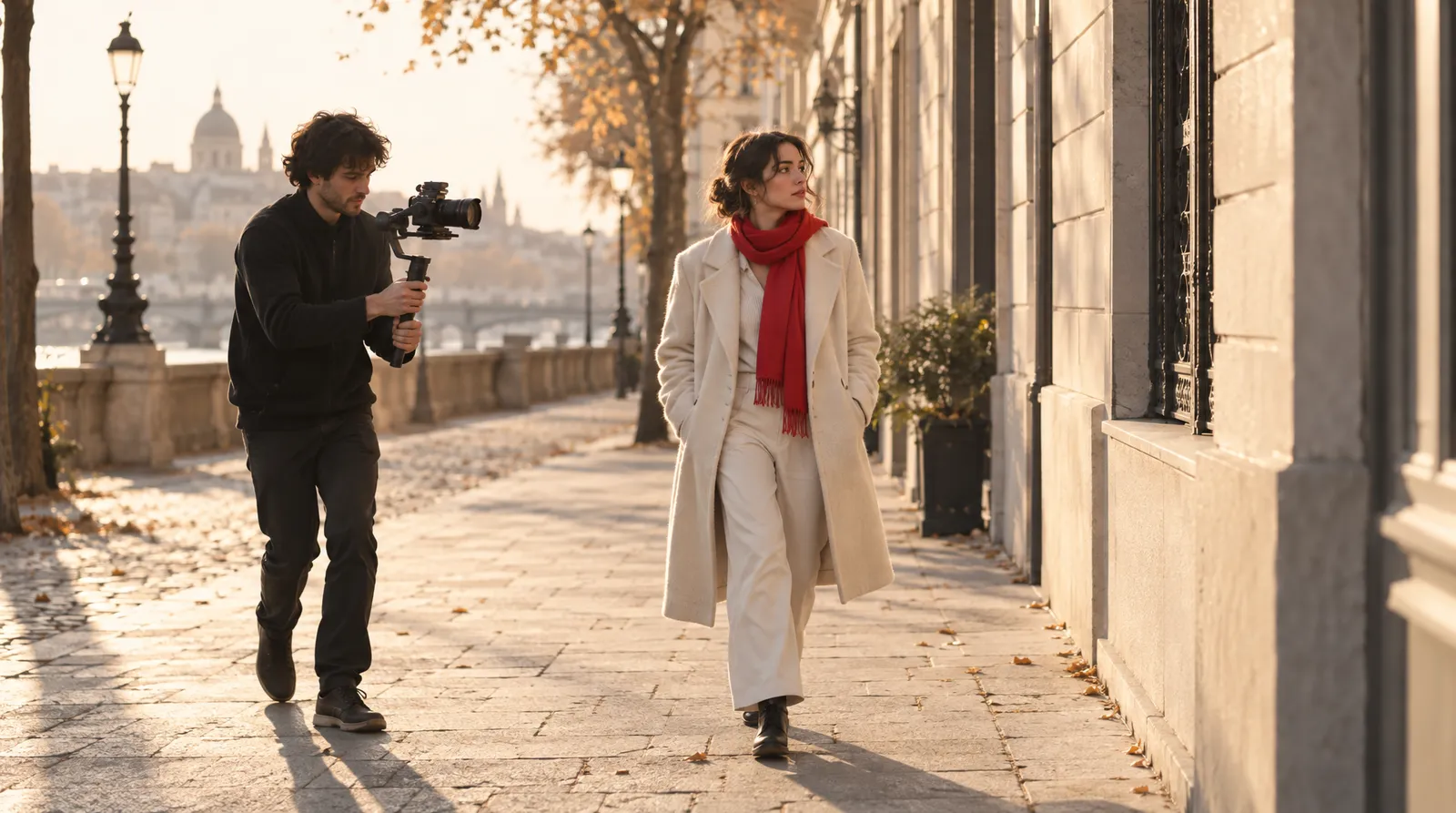
This guide covers the film meaning of a tracking shot. If you searched for shot tracking in golf or hockey, this isn't that page. It covers the main types, related terms, famous examples, gear and a planning method.
Facts were checked on November 9, 2026, and where sources disagree, we say so. The last section shows how to describe a tracking move in an AI video prompt. For every other move, see our guide to camera movements and angles.
What is a tracking shot in film?
A tracking shot is, in Wikipedia's words, "any shot where the camera follows backward, forward or moves alongside the subject being recorded." It's also called a travel shot, or a following shot, because the camera keeps up with a subject that would otherwise leave the frame. According to Videomaker, the camera usually keeps a constant distance and most often moves alongside the subject.
The name comes from dolly track. StudioBinder explains that "tracking" was once reserved for sideways moves on rails, with forward moves called push-ins or dolly-ins. Today the term covers shots made with gimbals, vest stabilizers, drones or handheld rigs. Celtx puts it well: the dolly is the tool, and the tracking shot is the result, no matter how it's achieved.
Types of tracking shots
Tracking shots are usually grouped by the direction the camera travels relative to the subject. Soundstripe names four main types (dolly, trucking, follow and oner), and Wikipedia adds circular moves and the phantom ride.
- Follow shot: the camera travels behind the subject, so the viewer sees what the character is walking into.
- Leading shot: the camera moves backward in front of the subject, keeping the face in view.
- Side or trucking shot: the camera slides left or right alongside the subject, the classic rail move.
- Push-in and pull-out: the camera moves toward or away from the subject, often called a dolly shot.
- Circular tracking: the camera arcs around the subject in a circle or semicircle while staying the same distance away.
- Aerial tracking: a drone follows a car, runner or boat from above.
- Phantom ride: the camera rides a train, roller coaster or other vehicle, a variant Wikipedia lists.
Tracking shot vs dolly, trucking, pan, zoom, Steadicam and long take
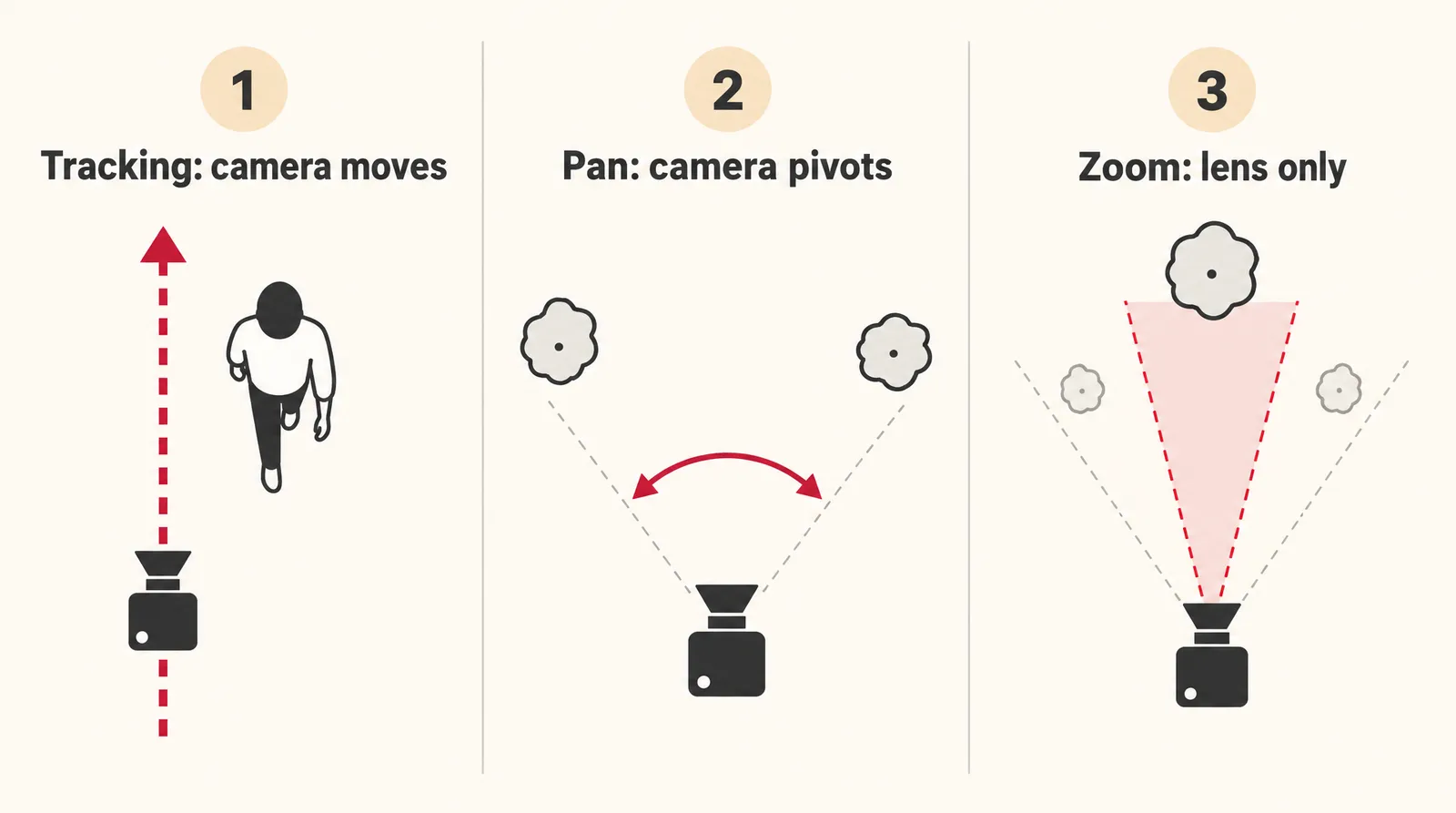
The short answer: a tracking shot means the camera body travels, while a pan only pivots and a zoom only changes the lens. Beyond that, the terms are used loosely. Wikipedia treats tracking as the umbrella with dolly and trucking as variations, while the Eastern Arizona College library guide calls a forward move a "tracking shot (or dolly shot)" and a sideways move "tracking (or trucking)." Treat these as industry habits, not a fixed standard.
Tracking shot compared with related terms
| Term | What moves | How it relates to tracking |
|---|---|---|
| Tracking shot | The camera travels with or around the subject | Umbrella term in most usage |
| Dolly shot | Camera on a wheeled platform, usually forward or back | Named after the rig; most dolly shots are tracking shots |
| Trucking shot | Camera slides left or right | Treated as a variation of tracking |
| Pan | Camera stays in place and pivots on its axis | No travel, so not a tracking shot |
| Zoom | Only the lens focal length changes | Camera stays put; the frame is just enlarged |
| Steadicam, gimbal, handheld | An operator carries the stabilized camera | Rigs used to get tracking shots, not shot types |
| Long take or oner | Nothing in particular; defined by length without a cut | May include tracking, but doesn't have to |
Sources: Wikipedia (Tracking shot, Long take), Celtx, Soundstripe, Eastern Arizona College LibGuide. Checked November 9, 2026.
Even the dolly overlap has exceptions. Soundstripe says "all dolly shots are tracking shots," but Epidemic Sound argues some aren't, and that "a dolly zoom isn't a tracking shot." Our dolly zoom guide explains that effect separately.
What is a tracking shot used for?
A tracking shot keeps the viewer moving with a character, so the audience feels present in the space instead of watching from outside.
- Following action: the subject stays in frame during a chase, walk or fight.
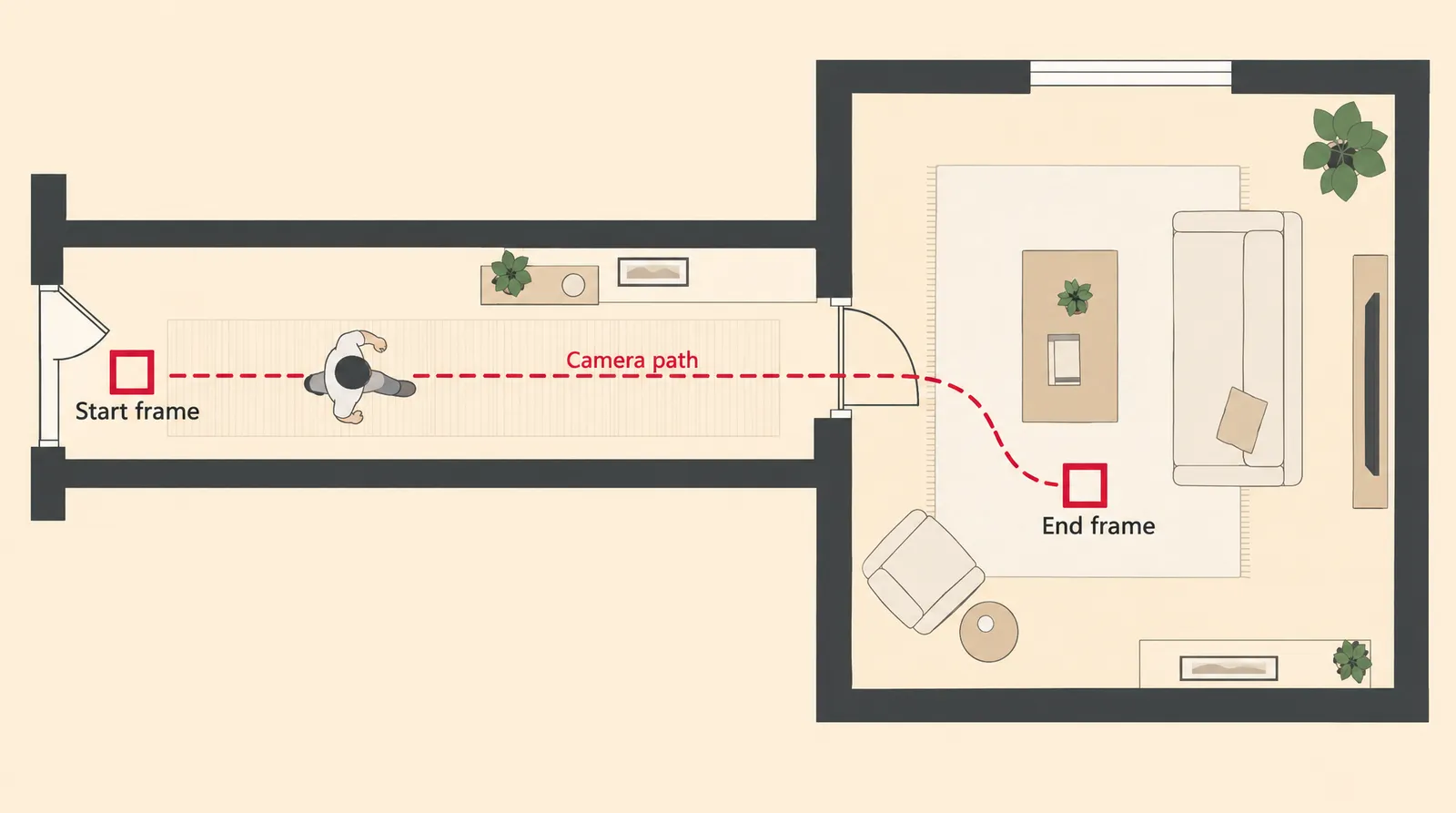
- Revealing a space: the camera passes walls, doorways or crowds, uncovering the location bit by bit, a moving cousin of the establishing shot.
- Building tension: no cut means no relief, so the viewer waits for what's around the corner.
- Showing status or character: in GoodFellas, Henry Hill walks Karen through the service entrance and kitchen straight into the Copacabana showroom, and the unbroken path shows how easily doors open for him.
Famous tracking shot examples in film
The best-known tracking shot examples are also long takes, which is why lists blur the two. Celtx names Wings (1927) as one of the earliest tracking shot examples. Lengths below are ranges because sources disagree: the Touch of Evil opener is called about 3 minutes by Soundstripe, three and a half by Far Out and four by Wikipedia's long take page.
Famous tracking shots and long takes
| Film | Year | Approximate length | How it moves |
|---|---|---|---|
| Rope | 1948 | Takes of up to 10 minutes | 11 shots joined with hidden transitions |
| Touch of Evil | 1958 | About 3 to 4 minutes | Crane and tracking hybrid following a car with a time bomb |
| The Shining | 1980 | Not specified | Steadicam tracking shots |
| GoodFellas | 1990 | About 3 minutes | Steadicam through the Copacabana kitchen |
| The Player | 1992 | About 8 minutes | Follows several characters in one shot |
| Children of Men | 2006 | About 6 minutes | Battle sequence with pre-planned crew positions |
| 1917 | 2019 | Not specified | Built to give the illusion of continuity |
Sources: Soundstripe, Wikipedia (Long take), Far Out, Videomaker, JoBlo. Lengths vary by source. Checked November 9, 2026.
The GoodFellas shot was filmed by cinematographer Michael Ballhaus, with Steadicam operator Larry McConkey credited by JoBlo, which calls it "nearly three minutes." According to IndieWire, the route came about partly because the club wouldn't let Scorsese film through the front door.
Gear for a tracking shot on any budget
You can film a tracking shot without a dolly: a motorized 3-axis gimbal is the most accessible option for indie filmmakers, according to Soundstripe citing No Film School. Here's how the main rigs compare.
- Dolly on track: the smoothest straight lines, but laying, leveling and testing track adds 20 to 40 minutes to a setup, per Soundstripe.
- Steadicam: introduced by Garrett Brown in 1975 and used for the tracking shots in The Shining and GoodFellas.
- Gimbal: cheap and fast for walking shots; practice a heel-to-toe walk to cut vertical bounce.
- Drone: has replaced cable cams for most high, long-distance tracking, but wind is a problem at low altitude.
- Vehicle mount: for car chases, bikes and the phantom-ride look.
- Handheld: deliberately rough; it still counts as tracking if the camera travels with the subject.
How to plan a tracking shot
Planning a tracking shot means locking the start frame, the end frame and everything the camera passes in between before anyone rolls. Children of Men's battle take needed pre-planned crew positions and several days of rehearsal, and smaller shots follow the same logic at a smaller scale.
- Pick the purpose: Write one sentence on what the move should do: follow, reveal, build tension or show status.
- Set the start and end frames: Choose the exact framing the shot opens on and the framing it lands on.
- Walk the path and set the distance: Walk the route with a phone, mark the floor with tape and decide how far the camera stays from the subject.
- Choose the speed: Match the camera to the subject's pace; walking pace reads as natural, slower reads as tense or dreamy.
- Block the actors and the reveal: Decide where actors enter, exit and turn, and what object or room appears at which moment.
- Rehearse with the full crew: Run the move with camera, focus puller, sound and extras until nobody steps into frame or casts a shadow.
- Shoot extra takes: Roll several takes and, if you might cut, plan a hidden transition point like a passing wall or doorway.
For the framing at each end, our shot types guide lists wide, medium and close options.
How to make a tracking shot with AI video
AI video models can produce a tracking shot if your prompt spells out the camera path, the speed, the distance and what passes through the frame. Vague words like "cinematic movement" leave the model to guess. A reusable pattern: subject and action, then "the camera tracks [alongside / behind / in front of] at [pace], keeping the same distance," then what is revealed, then "single continuous shot, no cuts."
Sample prompt: A woman in a red coat walks through a covered market at dusk. The camera tracks alongside her from the left at walking pace, keeping the same distance, as lantern-lit stalls slide past behind her. Single continuous shot, no cuts. It works because it names the side, the pace, the distance and the background motion that sells the travel.
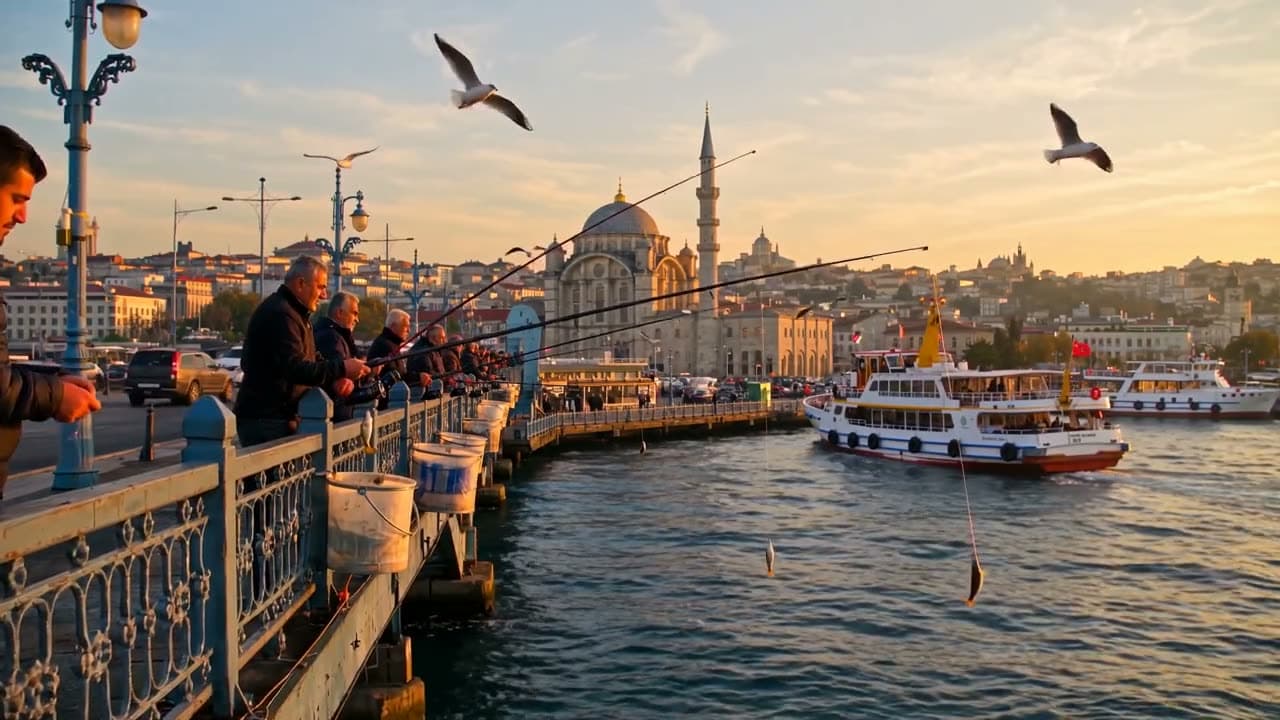

Each sample was generated in one take on this site with the model shown on it; nothing was edited.
On Klakix, Text to Video offers single shots up to 30 seconds with Kling 4.0, Seedance 2.5 and Wan 3.0. Kling 4.0 costs 79 credits by default (720p, 5 sec), which our math puts at about $5.27 on the Mini pack (79 × $5 / 75). Wan 3.0 is 100 credits for 10 seconds at 720p. Video unlocks after your first credit purchase, and credits are refunded automatically if a generation fails; see pricing, checked November 9, 2026, may change.
If you want to plan the move instead of describing it, the 3D Scene beta builds a simple blockout of your scene, lets you give each shot one of 16 camera moves, and then Seedance 2.5 Reference turns the blockout video into a realistic video with the same move. Camera work is free; the blockout and the final video cost credits. To start from a still frame, use Image to Video instead.
Sources
The facts in this post were checked against the pages below on Nov 9, 2026. Prices and limits may change.
- Wikipedia: Tracking shot (independent source)
- Wikipedia: Long take (independent source)
- StudioBinder: Tracking shot camera movement definition (independent source)
- Soundstripe: Tracking shot (independent source)
- Celtx: Tracking shot (independent source)
- Videomaker: The tracking shot defined (independent source)
- Epidemic Sound: What is a dolly shot (independent source)
- Eastern Arizona College LibGuide: camera movements (independent source)
- Far Out: The opening shot of Touch of Evil (news)
- JoBlo: GoodFellas tracking shot (news)
- IndieWire: Best long one-take shots in movies (news)
This post was drafted with AI assistance. Facts were checked against the sources above, and model, credit and price details were checked automatically against the site's current price list.
Frequently asked questions
What is a tracking shot in film?
A tracking shot is a shot where the camera physically travels with the subject, following behind, leading in front or moving alongside. It's also called a following shot or travel shot. The camera often keeps a constant distance from the subject.
What is the difference between a tracking shot and a dolly shot?
A dolly shot is named after the rig, a wheeled platform, and usually means moving toward or away from the subject. A tracking shot is named for the result: the camera travels with a subject, whatever carries it. Most dolly shots count as tracking shots, though some writers exclude effects like the dolly zoom.
Tracking shot vs pan: what's the difference?
In a pan the camera stays in one spot and pivots left or right on its axis, like turning your head. In a tracking shot the camera itself moves through space, like walking alongside someone. Backgrounds shift with parallax in a tracking shot but not in a pan.
Is a tracking shot the same as a long take or oner?
No. A long take, or oner, is defined by how long it runs without a cut, and it doesn't need any camera movement. A tracking shot is defined by camera travel and can last only a few seconds. Famous examples like GoodFellas happen to be both.
Tracking shot vs trucking shot?
A trucking shot moves the camera sideways, left or right, alongside the subject. Most sources treat it as one type of tracking shot. Historically, tracking itself meant exactly this sideways move on rails.
How long is the Goodfellas tracking shot?
Sources put the Copacabana shot at about three minutes, with some saying nearly three minutes. It follows Henry Hill and Karen through the service entrance and kitchen into the showroom without a cut. Soundstripe says it was shot with a Steadicam.
How do you film a tracking shot without a dolly?
Use a motorized 3-axis gimbal, a Steadicam, a drone or a vehicle mount, or go handheld for a rougher feel. A gimbal is the most affordable route for small crews. Mark the path on the floor and rehearse the walk to keep distance and speed steady.
Can AI video make a tracking shot?
Yes, if the prompt states the camera path, pace, distance and what passes through the frame. On Klakix, Kling 4.0, Seedance 2.5 and Wan 3.0 make single shots up to 30 seconds. Longer moves have to be joined from several clips in an editor.
Try what you just read
Signing up is free. Video and image tools unlock after your first credit pack, and credits are refunded if a generation fails.
Open Text to Video